- The Scarlet Letter
- Posts
- Thanks!


Are you interested in sponsoring the best local newsletter on the planet? Reply to this email to help your organization reach hundreds of thousands of engaged Columbusites.
Top of Mind
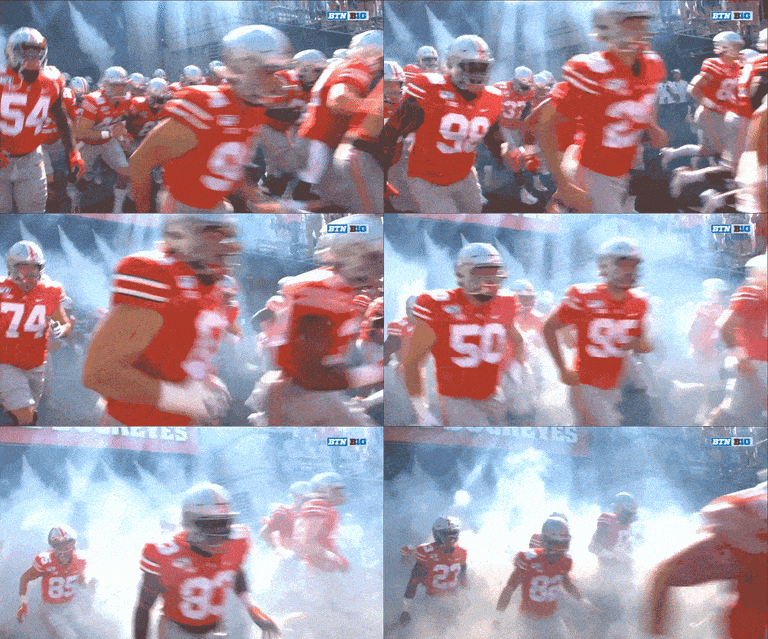
OHIO THANKSGIVING: TURKEYS, BORDER WARS, AND WHY THIS STATE GETS WEIRD IN LATE NOVEMBER
Thanksgiving is coming up, which means Ohio is preparing for its yearly rituals: eating too much, arguing over which cousin ruined the mashed potatoes, and crossing out the letter M like the alphabet personally wronged us.
But long before OSU started vandalizing signage for sport, Ohioans had their own Thanksgiving traditions, some practical, some historic, and some involving wild turkeys crashing through people’s houses on High Street.
Yes, really.
The History Before the History
Thanksgiving wasn’t always a fixed holiday. Before 1863, it wandered around the calendar like a confused relative who refuses to use Google Maps. Then Abraham Lincoln stepped in and declared it a national day of thanks during the Civil War — a unifying moment when the country desperately needed one.
From then until 1941, each president set the date individually through annual proclamations printed in local newspapers so people knew when, exactly, to stop working and start eating. Grover Cleveland’s 1887 proclamation encouraged the nation to dedicate the day to “thanksgiving and prayer,” which newspapers in Ohio dutifully reprinted between ads for coal, corsets, and cough syrup.
Once Congress standardized the fourth Thursday in November, the ritual stuck. So did the food.
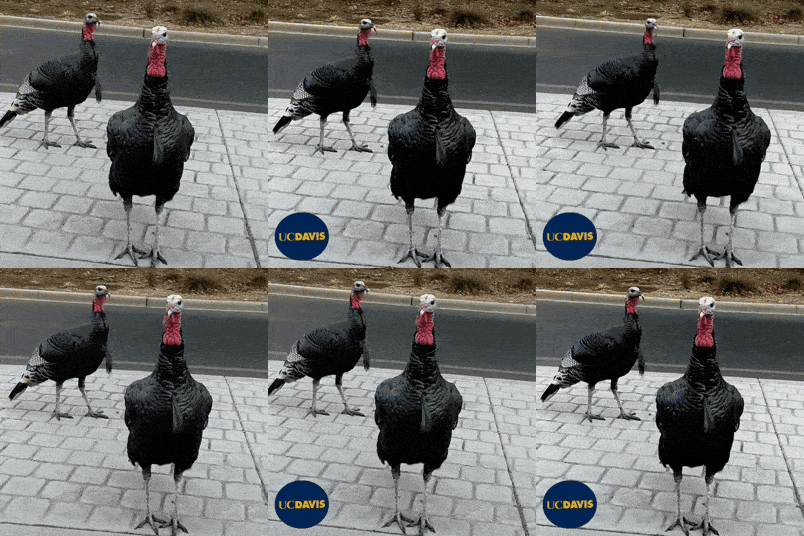
Ohio, Historically, Was Basically a Turkey Petting Zoo
Long before Butterball took over, Ohio’s wild turkey population roamed the state in numbers modern Columbus residents would describe as “honestly too many.” Early accounts tell stories like:
A wild turkey running straight into the old Merion homestead on South High Street, hiding on the bed, and getting caught like it was posing for a family photo.
A flock of 20+ wandering across the Hilltop in 1829.
Another flock landing where COSI sits today — promptly shot at by “sportsmen,” sending one turkey flying into a building where it knocked itself out and was casually retrieved.
This was normal. This was Ohio.
Turkeys were everywhere. And if Benjamin Franklin had gotten his way, one might have been on the national seal. He argued the turkey was “a more respectable Bird… a Bird of Courage.” As a result, the turkey became a central part of the holiday not just culturally but logistically. Soldiers in the Civil War were sent turkeys for Thanksgiving, cementing the bird’s place on American tables.
Meanwhile, Up North, Ohio Almost Fought a War Over Toledo
If you’re wondering why Thanksgiving weekend now doubles as the most intense sports rivalry in the country, the seeds were planted generations before Michigan ever built a football stadium.
Enter: The Toledo War, the most Midwest conflict imaginable.
Ohio and the Michigan Territory both claimed a 450-square-mile patch of land (including Toledo), and because 19th-century cartography was basically guesswork, no one could say for sure where the border actually was. Both states raised militias, drafted threats, and sent men with bayonets to stand around the Maumee River, giving each other mean looks.
The only recorded injury? A Michigan deputy was stabbed by a man named Two Stickney. And yes, that was his real name.
Eventually, President Andrew Jackson compromised:
Ohio got Toledo
Michigan got the Upper Peninsula
Everyone went home annoyed
Historians widely agree: the resentment from that dispute laid the groundwork for what became the Ohio State–Michigan rivalry, the one that now fuels the annual disappearing-M phenomenon around Columbus.

Thanksgiving Traditions That Have Stuck Around
Ohio’s old newspapers are full of early Thanksgiving customs:
Poems and essays about gratitude
Holiday travel reports (“Aunt Mabel returns from Zanesville”)
Illustrations of turkeys that look suspiciously judgmental
Ads for Lazarus, which stayed open until 1 PM on Thanksgiving in 1889, proving Black Friday creep is absolutely not new
Football-themed table décor, including a 1904 pumpkin painted like a college football, because Ohio State fandom predates electricity and reason
Much of what we do today, eat, gather, watch football, and complain politely, is unchanged from a century ago.
Gif by friends on Giphy
So What Is Ohio’s Thanksgiving Story?
A mix of:
frontier wildlife chaos
19th-century newspaper proclamations
a border dispute that nearly escalated into a war
The evolution of our biggest sports rivalry
families eating too much because Lincoln said so
The modern version, turkey, football, the annual red X over every M in town, is just Ohio layering new rituals onto the old ones.
And in a strange way, it all fits:
Thanksgiving is about history, land, identity, community, gratitude… and occasionally fighting your neighbor over who controls the Maumee River.
Happy Thanksgiving, Columbus. Enjoy the turkey. And if your family crosses out the M’s at dinner?
Just remind them: they’re participating in a tradition older than The Game itself.
Scarlet Letter Trivia
Question: How fast can wild turkeys fly and run
A) 55 mph and 18 mph
B) 88 mph and 88 mph
C) 10 mph 3 mph
D) 35 mph 9 mph
A New Habitat ReStore Just Landed in Hilliard and It’s Huge

Black Friday has a surprise challenger this year.
It is not Target.
It is not Best Buy.
It is not your uncle who camps outside Micro Center for “tradition.”
It is Habitat for Humanity.
Habitat Mid-Ohio just opened a brand-new 29,000-square-foot ReStore on Roberts Road in Hilliard. Think warehouse-sized aisles of discounted furniture, appliances, cabinets, home goods, and the kind of random treasures people insist they’ll “use someday” and occasionally do.
But here is what makes ReStores different from your typical bargain hunt:
Every dresser, appliance, light fixture, and stack of leftover tile sold in a ReStore helps build homes for families in central Ohio. ReStore revenue covers most of Habitat’s administrative costs, which means nearly every donated dollar can go straight into construction and repairs instead of overhead.
The numbers are real.
Nearly 100 families are served every year.
More than 2,000 tons of reusable material were kept out of landfills.
And thousands of Columbus residents donated the chair they swore they would reupholster in 2019.
Why the Hilliard Store Matters
Hilliard is one of the fastest-growing corners of the region and now has its own one-stop shop for anyone who is:
furnishing a new home
renovating a room
stocking up for a DIY project
or just wandering around asking, “What do you think this used to be”
The new ReStore is open Tuesday through Saturday from 9 to 5. Black Friday will have giveaways, special pricing, and opening-week deals exclusive to the Roberts Road location.

How to Support the Mission
You can shop.
You can donate.
You can do both and feel like you made a dent in the world today.
Every gently used appliance, piece of furniture, tool, or leftover material helps Habitat keep inventory moving and makes homeownership possible for more families in central Ohio.
Not near Hilliard? You have options:
Westerville, 3140 Westerville Road
Bethel Road, 2555 Bethel Road
Newark, 1660 N. 21st Street
The Bottom Line
This is more than a new store.
It is a visible reminder that affordable housing isn’t an unsolvable problem. It is a community project. One donated nightstand at a time.
To follow new inventory and updates, check their Facebook page.
To volunteer or support events, join their newsletter.

THE OHIO HOUSE JUST PASSED A BILL TELLING TEACHERS TO “BE MORE POSITIVE ABOUT RELIGION.” YES, THIS IS A REAL STORY.
Columbus lawmakers are back at it, this time passing something called the Charlie Kirk American Heritage Act, a name that already feels like it was generated by a malfunctioning Twitter bot.
House Bill 486 would require Ohio public school teachers to highlight the positive influence of religion, specifically Christianity, in American history lessons. Not the full picture. Not the complicated picture. Just the “good vibes only” part.
It passed 62–27, with Republicans voting yes and Democrats voting no.
A perfect, predictable, straight-down-the-middle partisan split.
Ohio politics, everyone.
What the Bill Actually Does
Ohio’s current learning standards already include Christianity, Indigenous religions, Judaism, Islam, and more, without adjectives.
Teachers can already talk about John Witherspoon, the Puritans, abolitionist pastors, religious liberty, and every sermon that ever made it into a Ken Burns documentary.
But HB 486 goes further. Much further.
It instructs teachers to emphasize the positive impacts of religion and includes a list of suggested “uplifting examples,” such as:
The faith of the Pilgrims
the Christian theology behind the Founders’ writings
Witherspoon signing the Declaration
the “divine purpose” of early American movements
Basically: history class, sponsored by a curated highlight reel.
Who’s On Board
Supporters say the bill corrects an imbalance and “reminds teachers” they’re allowed to talk about Christianity in a flattering light. One advocate said it would help students learn the moral fiber that “bound our republic together.”
Another said it would put Christianity on equal footing with trips to the Jewish Heritage Museum or school celebrations of the Lunar New Year.
Charlie Kirk’s name is attached because legislators wanted to honor him following his death, a symbolic gesture from the Statehouse to Turning Point USA’s base.
Who’s Not On Board
Opposition came from:
educators
historians
interfaith groups
advocates for the separation of church and state
and , Christian organizations
Their argument?
Not that religion shouldn’t be taught.
But that teaching only the positive parts is the opposite of actual history.
Critics pointed out the bill’s recommended lessons include interpretations like the first Thanksgiving being purely an expression of Christian gratitude, while leaving out Indigenous spiritual practices or the realities of colonial power.
One testimony said the bill “presents students with only half the story.”
Another noted that Christianity was also used to justify slavery and manifest destiny — two fairly essential parts of America’s actual timeline.
What This Moment Says About Ohio
Every year, Thanksgiving returns and Ohio revisits the same old question:
How do we tell our history honestly?
This bill answers with:
“Tell the good parts louder.”
And that’s the tension.
History is never one thing. It’s sacred and broken, inspiring and uncomfortable, full of courage and contradiction, usually in the same chapter.
Ohio’s classrooms already teach religion.
HB 486 just wants to make sure “positive” comes attached as a mandatory adjective.
What Happens Next
HB 486 now moves to the Senate.
If it clears that chamber, it heads to the governor’s desk.
Whether it becomes law or not, one thing is clear:
Ohio is still wrestling with how to tell its own story, the real one, the whole one, the messy one, even as the Statehouse tries to tidy up the edges.
Trivia Answer:
A: Them suckers fly at 55 mph and can run 18 mph…crazy and sorta scary