- The Scarlet Letter
- Posts
- Bummer from COSI

“I believe that unarmed truth and unconditional love will have the final word in reality. This is why, right, temporarily defeated, is stronger than evil triumphant.”
MLK Day is a reminder that this wasn’t just a beautiful sentiment; it was a strategy. In a world that feels louder, harsher, and more allergic to nuance by the day, his point still lands: truth does not need a weapon to win, and love is not soft when it is disciplined. If we’re going to honor him, it can’t just be with quotes and a day off. It has to be with the kind of courage that stays human, even when it would be easier to be cruel.
Are you interested in sponsoring the best local newsletter on the planet? Reply to this email to help your organization reach hundreds of thousands of engaged Columbusites.
Top of Mind
Why We Call It “Gubernatorial” (And Why It Sounds Like A Victorian Illness)
As Ohio heads into a governor’s race in 2026, you are about to hear the word “gubernatorial” said with the confidence of someone who also uses “aforementioned” in a text message. It is one of those political words that feels like it was invented specifically so insiders can sound like they have a lanyard. And yes, it is objectively weird that we get from governor to gubernatorial instead of the very normal-sounding “governatorial,” which is a word that looks right, sounds right, and would save all of us from this spelling situation.
Here’s what happened.
“Governor” came into English through French back in the 1300s, basically meaning what it means now: a person responsible for governing something. But English, being English, later circled back during the Renaissance and borrowed from Latin too, because nothing says “intellectual glow-up” like grabbing the same concept twice in different outfits. The Latin form gubernator (governor) did not really stick around as a common noun in English, but its adjective form did. That is how we ended up with gubernatorial.
Now here’s the part that makes the word slightly less ugly and way more interesting.

Gif by election2020 on Giphy
The Latin gubernator traces back to Greek roots tied to steering a ship, specifically the idea of a helmsman, someone literally holding the wheel and keeping things pointed in the right direction. That metaphor is so perfect it almost feels unfair. Because if you have ever watched Ohio politics for more than ten minutes, you know the state is basically a large vessel where everyone is yelling directions from the deck while somebody tries to steer through fog.
Even better, that same Greek root is connected to cybernetics, the study of systems, control, and feedback loops. So every time a talking head says “the gubernatorial race,” they are accidentally referencing ancient ship navigation and the science of controlling complex systems.
Which is honestly the most accurate description of governing I have heard in years. Also, the word has enemies. A lot of them.

Gif by news on Giphy
The New York Times Manual of Style and Usage reportedly calls “gubernatorial” stilted and suggests writing “the race for governor” or “the campaign for governor” instead. Which is a very New York Times thing to say, because yes, it is stilted, but also, have you met political people?
Stilted is their love language. And if you think the dislike is modern, it is not. There is a long tradition of people complaining about “gubernatorial,” as if it personally ruined their day. Even serious language writers have taken shots at it over the years, because it sounds pompous even when used correctly. So why do we keep it? Because it is useful. It is the single-word adjective that headlines and election nerds can slap onto anything: gubernatorial debate, gubernatorial field, gubernatorial fundraising, gubernatorial chaos. And, as some editors will tell you, it is sometimes genuinely shorter and cleaner than repeatedly writing “race for governor,” especially when space is tight.
Now, the practical part: Ohio’s primary is May 5, 2026, and the general election is November 3, 2026. If you live in Columbus, that means the next year is going to be full of state-level decisions that land directly on your doorstep, whether the topic is schools, housing, transit, jobs, or whatever fresh policy idea shows up wearing a “common sense” hoodie.
So yes, we are going to cover the governor’s race heavily. And we are going to do it in plain English whenever possible. But every once in a while, we are absolutely going to say “gubernatorial,” because it is election season and we deserve one silly word that also secretly means “the person steering the ship.”
Scarlet Letter Trivia
Question: How many governors has Ohio had?
A) 70
B) 60
C) 80
D) 50
COSI’s New Exhibit: Executive Compensation
COSI just laid off 15% of its staff this month, citing attendance and funding changes.
Which is a bleak sentence for a place that basically runs on school field trips, sticky fingers, and the annual tradition of parents realizing “membership is cheaper than leaving the house in January.”
And yet, if you want to understand what’s been happening inside our beloved science museum over the last few years, you don’t need a microscope. You need a calculator.
COSI’s nonprofit tax filings (under its legal name, the Franklin County Historical Society) show a financial roller coaster:
2020: net income of -$2.6M
2021: net income of +$6.1M
2023: net income of +$524K
2024: net income of -$1.35M
So yes, “turbulent” is fair. But here’s where it gets spicy (or, in COSI terms, where the chemical reaction starts bubbling).
In 2020, COSI reported $481,951 in “Executive Compensation” and $6,415,925 in “Other Salaries and Wages.” That means exec comp was about 7% of payroll (exec comp divided by exec comp + other wages).
pushing exec comp to about 10.6% of payroll.
By 2024, executive compensation was reported at $1,770,443 with $9,517,658 in other wages, making exec comp about 15.7% of payroll.
That is a real trend. And it lands differently when the same institution is simultaneously telling the public it had to cut jobs.
Then there’s CEO compensation.
COSI’s filings list Frederic M. Bertley at:
$292,978 in 2020
$378,966 in 2021
$427,476 in 2023
$484,142 in 2024
So while the museum’s finances went from “pandemic disaster” to “temporary comeback” to “back in the red,” the CEO line kept doing what it does best: trending up and to the right.

Also, Bertley is not just running COSI. He’s listed as the CEO of the National Veterans Memorial and Museum too. Which is impressive, if you’re into the “two CEO titles at once” lifestyle. The rest of us are still trying to answer emails before lunch.
None of this is to say COSI is evil. It’s to say that when a family museum starts laying people off while executive pay becomes a bigger slice of the payroll pie, people are going to ask questions. And if the goal is to inspire curiosity, congratulations, mission accomplished.
Want the real hands-on experience? Open the filings, and start poking around.
FYR Turns Up The Heat In The Short North

Columbus restaurants love a “new menu” announcement. Usually, it means two new apps and a cocktail with rosemary on fire.
FYR Short North actually did the thing.
Inside the Hilton Downtown at 402 N. High St., FYR rolled out a reworked menu built around wood-fire cooking, with a heavy lean into Ohio-sourced ingredients and seasonal flavors.
What’s new
The highlights are basically a greatest-hits list for anyone who enjoys dinner with a little drama:
Wood-oven crab cake
Wagyu Royale with citrus-fed Australian Wagyu and Ohio Raclette
Ora King salmon
Local vegetables
Bone marrow whipped potatoes, which feel like a dare
They’re also running a dry-aging program for meats with bourbon basting, because FYR would like your steak to taste like it has a personal brand.
New chef, same obsession with fire
The menu is led by Executive Chef Zachery Warn, a 25-year veteran with time in Napa and Vegas kitchens. His pitch is simple: respect the ingredient, then cook it like it owes you money.
Dessert and cocktails got the memo
Dessert and drinks keep the theme going:
Build-your-own banana split
Basque cheesecake with toasted meringue and smoke chocolate ganache
Martinis made with fire-roasted ingredients
If you go
Open 4 to 9 p.m. Monday to Thursday, and 4 to 11 p.m. Friday and Saturday.
Bottom line: if you want a downtown dinner that feels like an event without being stiff, FYR is making a case.
Brutus Pulled A Heist In Orlando And Got Away With It
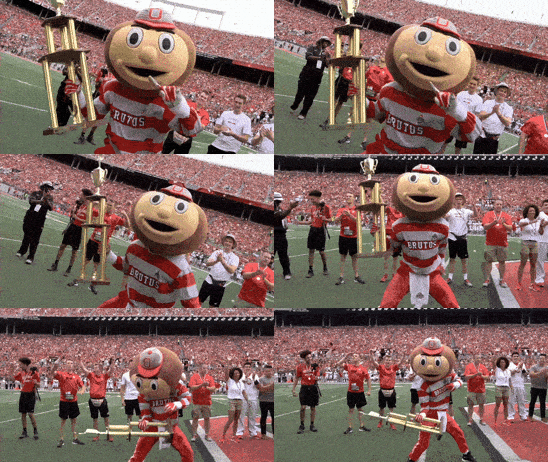
If you were worried Ohio State might go a full week without winning something, relax. Brutus Buckeye is a national champion again.
On January 17, Brutus took first place in the Division IA Mascot competition at the 2026 UCA & UDA College Cheerleading and Dance Team National Championship at ESPN Wide World of Sports in Orlando. It’s his first mascot national title since 2019, which is both a fun stat and a reminder that time moves faster than you think, especially when your main hobby is watching a large nut do backflips.
Here’s the part most people don’t realize: mascots don’t just show up, wave, and accidentally knock over a kid’s nachos. To even make nationals, schools submit an entry video, get scored out of 100, and only the top 10 get invited to perform live. That video score makes up half of the final score, so yes, there is an entire serious judging system devoted to costumed chaos. This year, Brutus’ video came in fourth, behind a stack of heavy hitters, including Minnesota’s Goldy Gopher.
Then came the live performance, a 90-second skit written by the spirit squad and coaches. The theme: bank heist, with Brutus on a mission to steal the championship ring. Because if you’re going to compete for a national title in mascot division, you might as well commit to a plot that sounds like a direct-to-streaming action movie called Fast and Furriest.
Ohio State’s head mascot coach Ray Sharp gave the most important reminder in all of this: there’s a whole support team behind Brutus, and they put a ridiculous amount of time into getting this right. Which makes sense. The margin between “national champion” and “guy in a suit doing the worm” is apparently a lot of practice, props, choreography, and crowd work.
Final standings in Division IA Mascot looked like this:
Ohio State, Brutus Buckeye
Minnesota, Goldy Gopher
Tennessee, Smokey
Cincinnati, Cincy Bearcat
Auburn, Aubie the Tiger
Wisconsin, Bucky Badger
Alabama, Big Al
Penn State, Nittany Lion
Oklahoma, Boomer
Texas, Hook Em
Gif by ohiostathletics on Giphy
So yes, Columbus can officially brag about another national title, and this one came from a giant nut committing a staged felony in Florida. If that isn’t the perfect summary of college sports culture, nothing is.
Trivia Answer:
A) 70 Gubernatorial

Till Next Week!
